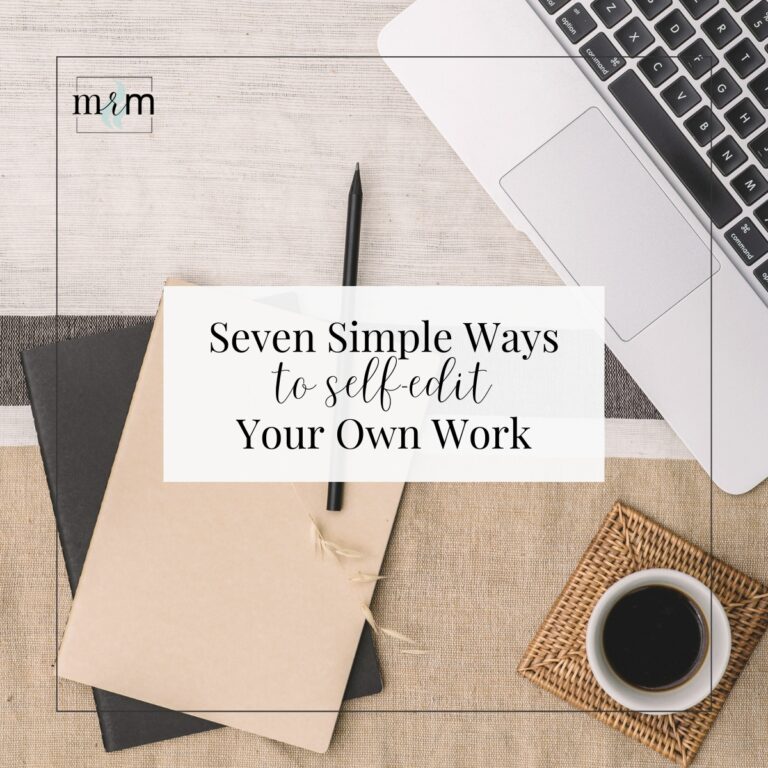
Self-editing is one of the most valuable skills a writer can develop. Before your manuscript reaches a professional editor or your audience, taking the time to refine your own work demonstrates professionalism and respect for your craft. Self-editing sharpens your ideas, clarifies your message, eliminates distracting errors, and strengthens your voice. It transforms a rough draft into a polished piece that communicates effectively.
While professional editing remains essential, thorough self-editing ensures you present your best work and maximizes the value you receive from professional editorial services.
Editing Basics for Authors
Every manuscript contains common pitfalls: misspellings, grammatical inconsistencies, awkward phrasing, repetitive language, unclear transitions, and structural weaknesses. These issues aren’t signs of poor writing—they’re natural byproducts of the creative process. The challenge lies in detecting them. As authors, we’re intimately familiar with our own work, which creates blind spots. Our brains autocorrect as we read, filling in gaps and overlooking mistakes because we know what we meant to say.
Effective self-editing requires strategies that help us see our work with fresh perspective and catch errors that would otherwise remain hidden.
Self-Editing Tips
- Step away from your work. Distance is your greatest ally in self-editing. After completing a draft, set it aside for at least one to two weeks. When you return, you’ll read with fresh eyes and notice issues that were previously invisible. If you’re on a tight deadline, even a few days can help reset your perspective.
- Read in a different format. Change your manuscript’s appearance to disrupt familiar reading patterns. Switch to an unusual font, increase the font size significantly, adjust line spacing, or print your work on paper. These changes force your brain to process each word more deliberately, making errors easier to spot.
- Read aloud slowly. Your eyes may skip over mistakes, but your ears won’t. Reading aloud reveals awkward sentences, missing words, repetitive phrasing, and rhythm problems. Take your time and listen carefully. Alternatively, use text-to-speech software to hear your work read by a neutral voice, which provides additional distance from the text.
- Focus on one element at a time. Don’t try to catch everything in a single pass. Make separate editing passes for different concerns: one for grammar and spelling, another for sentence structure and flow, another for consistency in terminology or character details, and another for overall clarity and logic. This targeted approach prevents overwhelm and increases accuracy.
- Eliminate unnecessary content. Question every paragraph, sentence, and word. Does it serve your purpose? Does it add value for the reader? Remove tangents, redundancies, and self-indulgent passages that don’t advance your message. Save deleted sections in a separate file—they might work as supplementary content or future projects.
- Check for consistency. Verify that character names, dates, locations, formatting, terminology, and style choices remain consistent throughout. Create a style sheet documenting your decisions about capitalization, hyphenation, spelling variants, and other recurring elements.
- Use editing tools wisely. Grammar checkers and editing software can identify potential issues, but they’re not without fault sometimes. Review each suggestion critically and maintain your authentic voice. These tools work best as aids to your judgment, not replacements for it.
What Professional Editors Bring to Your Manuscript
Hiring a professional editor is one of the most important investments an author can make for their manuscript. While self-editing helps you catch obvious errors and refine your ideas, a professional editor brings objective expertise, fresh perspective, and specialized skills that transform good writing into exceptional work. They identify structural weaknesses you can’t see, polish your prose to professional standards, and ensure your message resonates clearly with your intended audience.
A skilled editor doesn’t just correct mistakes—they elevate your entire manuscript, helping you communicate more effectively and present your best work to readers. Ultimately, professional editing is the difference between a manuscript that’s merely finished and one that’s truly ready for publication.
Developmental Editors evaluate the big picture: structure, organization, argument flow, narrative arc, pacing, and content development. They ensure your ideas connect logically, identify gaps or redundancies, suggest reorganization for maximum impact, and help strengthen your overall message. For fiction, they assess plot structure, character development, dialogue, theme, and world-building coherence.
Line Editors and Copy Editors refine your writing at the sentence and paragraph level. They improve clarity and readability, eliminate wordiness, enhance word choice and sentence variety, fix grammatical and punctuation errors, ensure consistent style and tone, verify facts and citations, and resolve continuity issues. Their work makes your writing more engaging and precise.
Proofreaders conduct the final review before publication, catching residual typos, spelling errors, punctuation mistakes, formatting inconsistencies, incorrect page references, and other surface-level issues. They provide quality assurance that your manuscript is print-ready and professional.
Some Final Thoughts
Self-editing isn’t a substitute for professional editing, but it’s an essential first step that every serious author must take. The effort you invest in self-editing makes your manuscript stronger, helps your professional editor work more efficiently, and reduces your editing costs. Most importantly, it develops your editorial eye, making you a better writer over time. Approach self-editing systematically, using multiple strategies and passes through your manuscript.
Remember that even accomplished authors rely on editors, because the goal isn’t to achieve perfection independently, but to present your strongest possible draft for professional refinement. By combining diligent self-editing with professional editorial support, you give your work the foundation it needs to connect powerfully with readers.
This post may contain affiliate links. Read our full affiliate disclosure here.